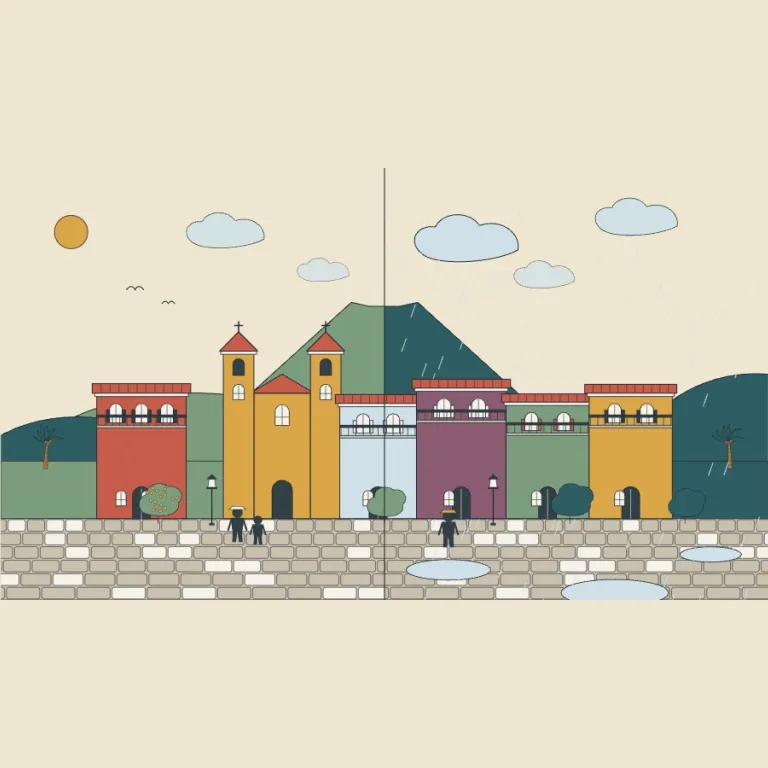
The best time to visit Nicaragua is December to April, the dry season that the national weather service INETER runs from November to April. San Juan del Sur records 0.2 in (5 mm) of rain over 2 days in February, against 12.9 in (328 mm) over 28 days in October. Avoid September and October, the two wettest months on both coasts. Note one catch: the Pacific sea cools to 78 °F (26 °C) in February when the Papagayo winds blow. Start from the MyNicaraguaStay home page.
Nicaragua at a glance
- Best overall window: December to April on the Pacific and around the lakes, February to April on the Corn Islands.
- Worst window: September and October, with 27 and 28 rainy days at San Juan del Sur.
- Hottest month: April, with 89 °F (32 °C) at San Juan del Sur and 94 °F (35 °C) at León.
- Sea temperature: 78 to 85 °F (26 to 29 °C) on the Pacific, 82 to 85 °F (28 to 30 °C) off the Corn Islands.
- Busiest month: December, with 178,018 arrivals in 2019 against a monthly average of 107,935.
- Domestic peak: Semana Santa, when INTUR counted 5,806,819 people on the move in 2026.
- Hurricane exposure: the Caribbean coast, not the Pacific. Eta came ashore near Puerto Cabezas on 3 November 2020.
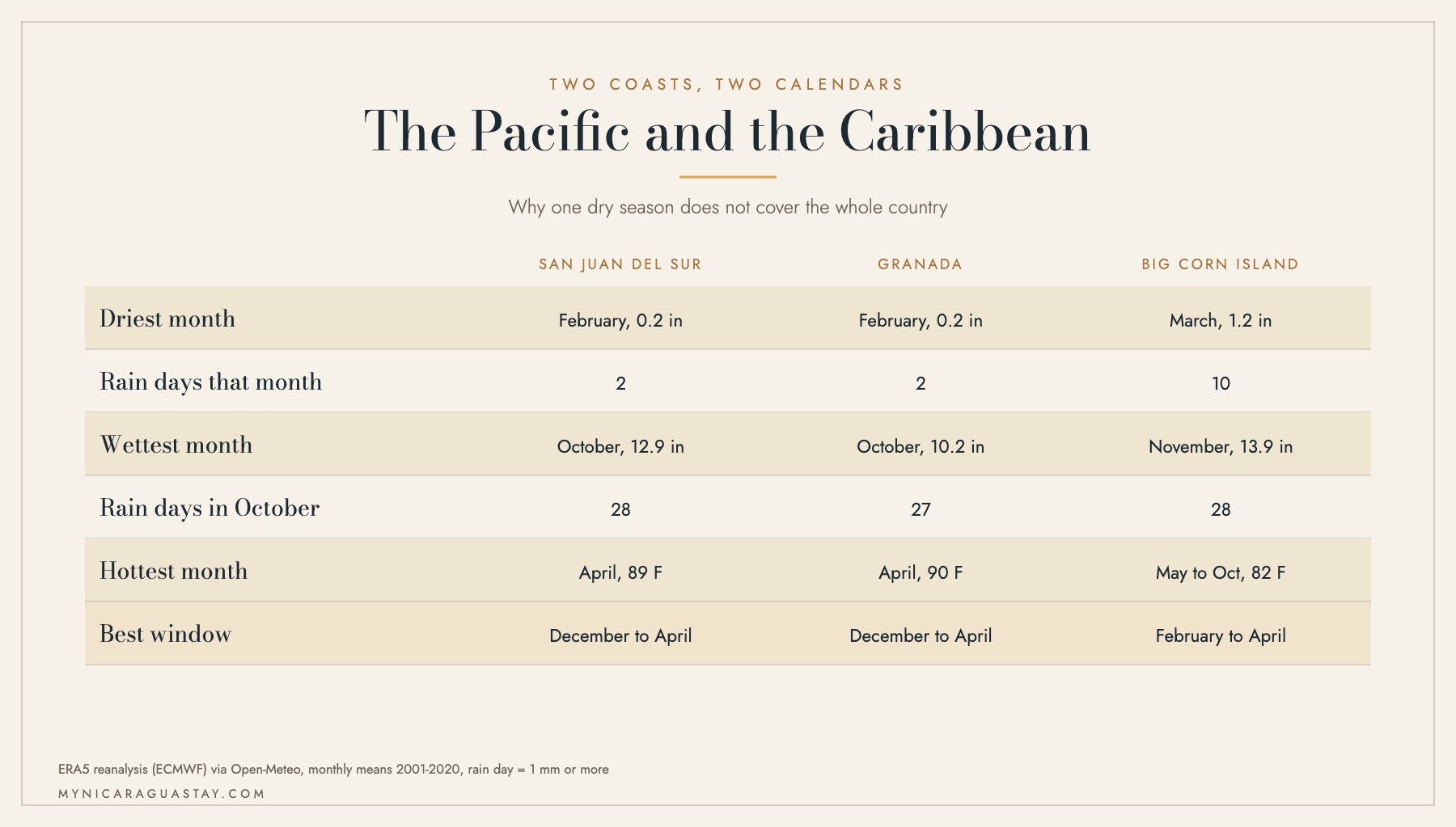
The Pacific and the Caribbean do not share a dry season. Source: ERA5 reanalysis (ECMWF) via Open-Meteo, 2001-2020.
Understanding the climate: two coasts, two calendars
Nicaragua is split by its own geography. INETER, the Instituto Nicaragüense de Estudios Territoriales, defines the year on the Pacific side and across the north and centre as a rainy season from May to October and a dry season from November to April. The Caribbean side does not follow that rule: it rains there in most months, and its only genuine dry window is short, around March and April.
The figures here come from the ERA5 reanalysis (ECMWF) served by Open-Meteo, monthly means for 2001 to 2020, with a rainy day counted as a day with 1 mm or more.
The Pacific coast: San Juan del Sur and Tola
The dry season here is close to absolute. February and March each record 0.2 in (5 mm) across 2 days, and December still only 1.1 in (29 mm). Highs climb from 83 °F (28 °C) in January to 89 °F (32 °C) in April, the hottest and dustiest month, then the rains break in May and the coast turns green within a fortnight.
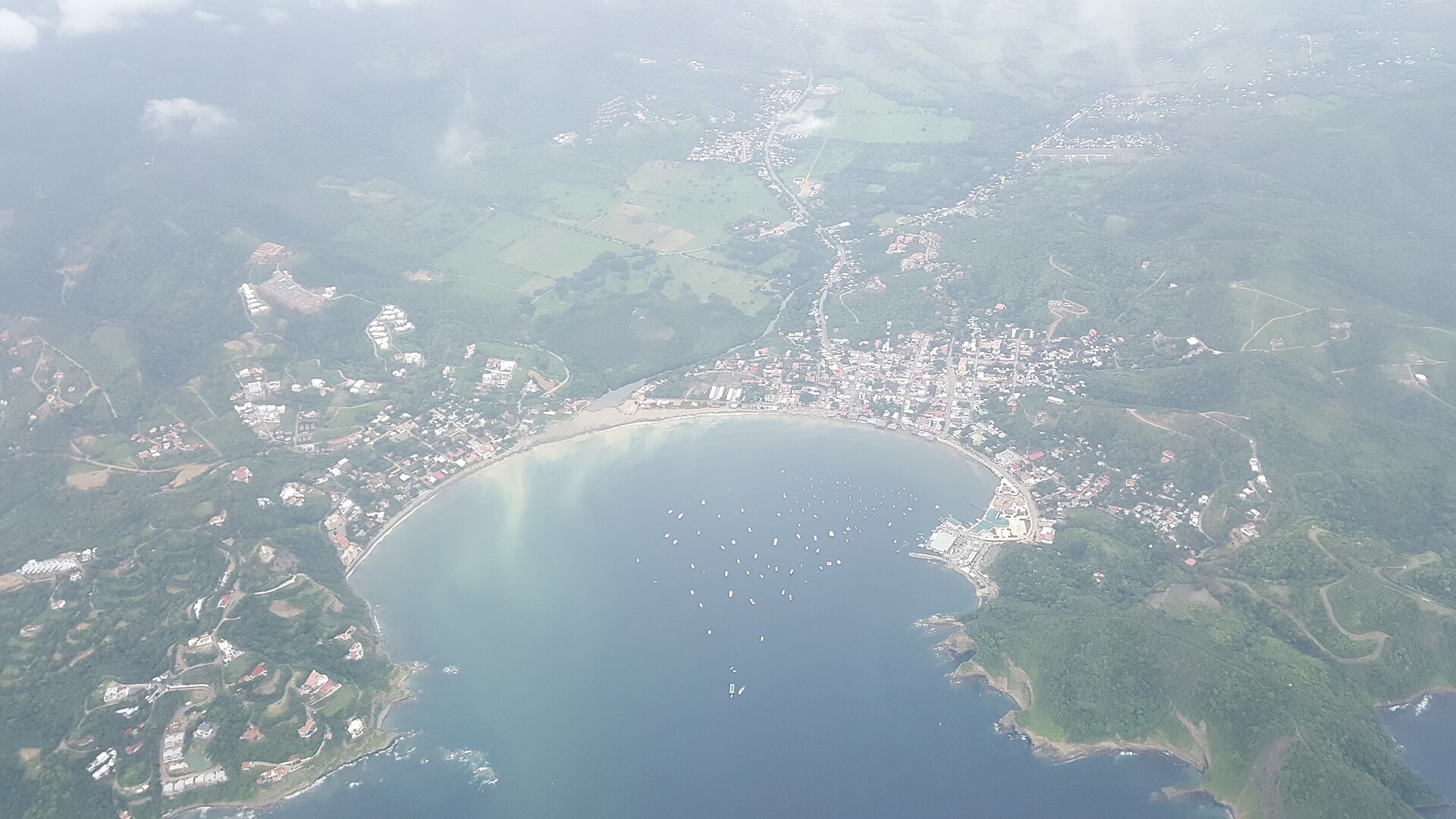
The bay of San Juan del Sur from the air. Photo: <a href="https://commons.wikimedia.org/wiki/File:San_Juan_del_Sur,_Nicaragua._View_from_SANSA_Flight_(Liberia-Costa_Esmeralda).jpg">JorgeRodriguez</a>, Wikimedia Commons, <a href="https://creativecommons.org/licenses/by-sa/4.0/">CC BY-SA 4.0</a>. Photo : JorgeRodriguez, Wikimedia Commons, CC BY-SA 4.0.
.jpg)
The bay of San Juan del Sur from the air. Photo: JorgeRodriguez, Wikimedia Commons, CC BY-SA 4.0.
The lake cities: Granada, Masaya and León
Granada follows the same calendar, with 0.2 in (5 mm) in each of January, February and March and 10.2 in (258 mm) in October. León, on the hot northwestern plain, is the extreme case: 94 °F (35 °C) in March and April, 0.1 in (2 mm) of rain in January, then 16.3 in (415 mm) in October. Walking Granada or León in April means starting at seven and stopping at eleven.
The Caribbean coast: Big Corn Island and Bluefields
This is the part most guides skip. Big Corn Island records 1.2 in (30 mm) in March and 1.6 in (41 mm) in April, then more than 9 in (235 mm) every month from June to November, peaking at 13.9 in (352 mm) in November. Bluefields, on the mainland, is wetter still, at 15.2 in (385 mm) in July. Air temperature barely moves all year, from 80 to 82 °F (27 to 28 °C), and the sea sits between 82 and 85 °F (28 and 30 °C). The practical rule: the Corn Islands are at their best in March and April, a month or two after the Pacific peak.
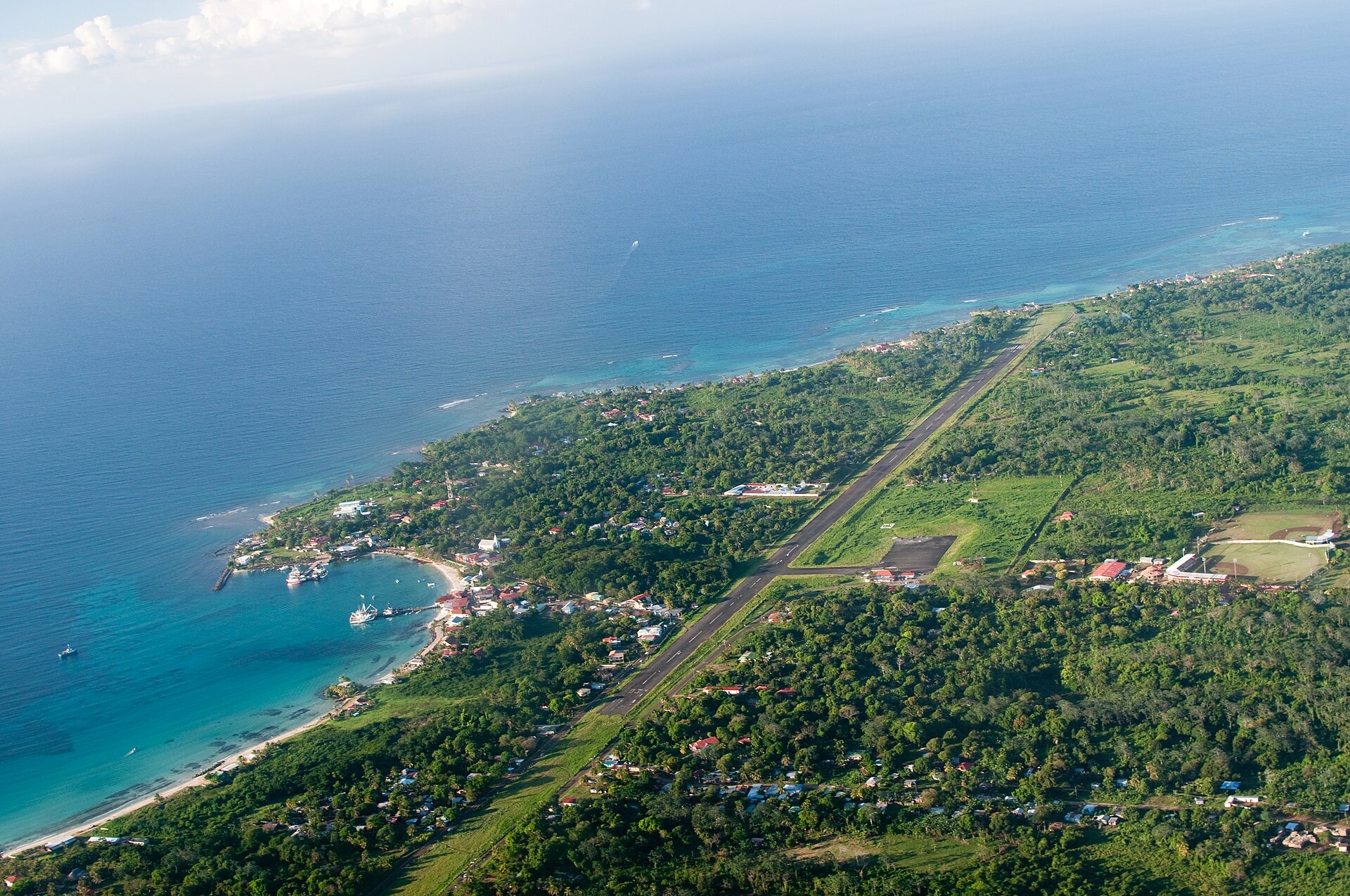
Big Corn Island from the air. Photo: <a href="https://commons.wikimedia.org/wiki/File:Aeropuerto_Corn_Island.jpg">Brian Johnson and Dane Kantner</a>, Wikimedia Commons, <a href="https://creativecommons.org/licenses/by-sa/2.0/">CC BY-SA 2.0</a>. Photo : Brian Johnson and Dane Kantner, Wikimedia Commons, CC BY-SA 2.0.

Big Corn Island from the air. Photo: Brian Johnson and Dane Kantner, Wikimedia Commons, CC BY-SA 2.0.
The dry season: November to April
The dry season is the reason to come, and it has two halves. November and December are the green half: the rain has stopped, the hills are still lush, and the sea is 81 to 82 °F (27 to 28 °C). March and April are the brown half: the landscape dries out, León and Chinandega reach the high nineties, and the smoke of field burning can thin the light in the west.
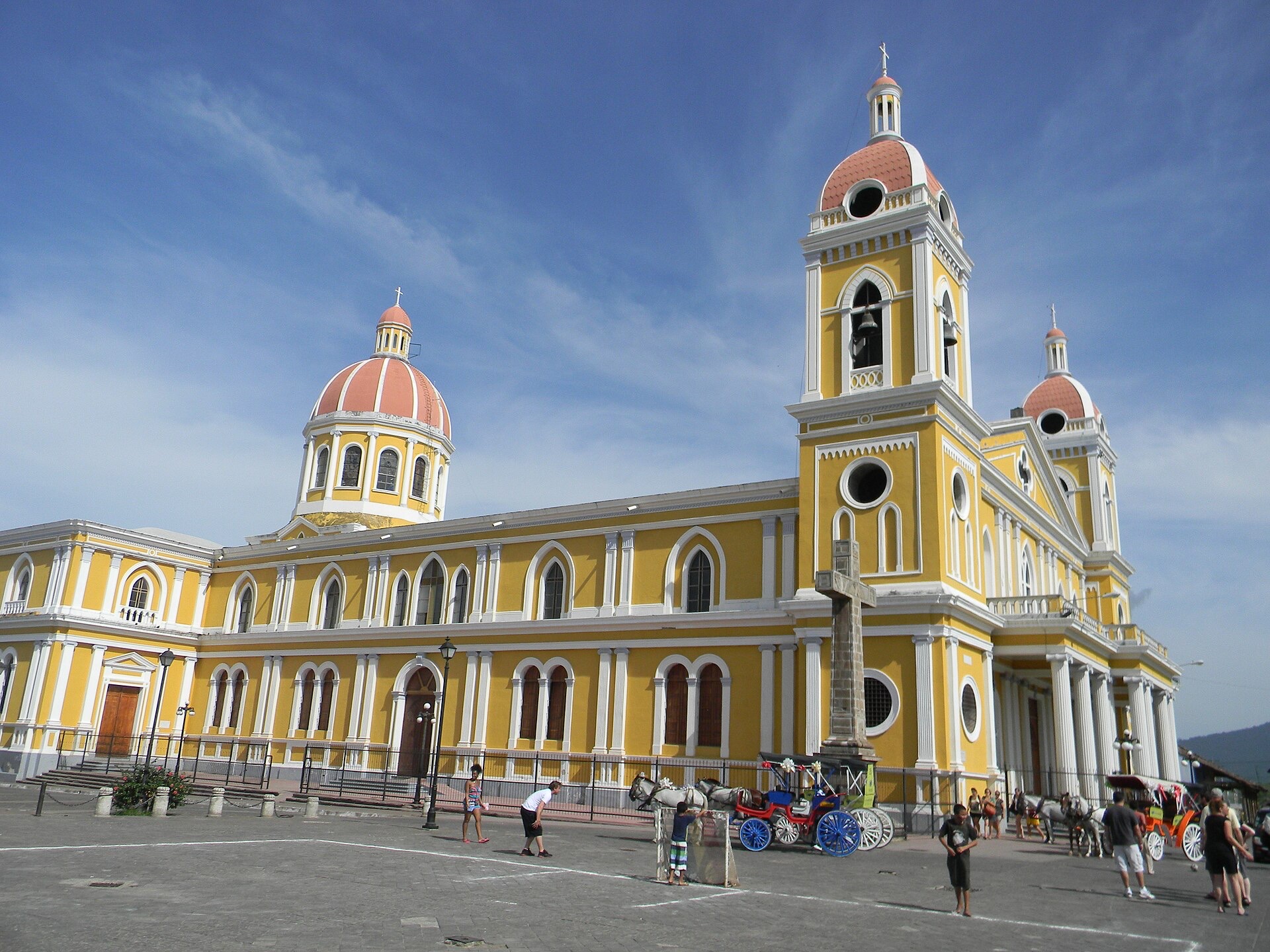
The cathedral and the Parque Central in Granada. Photo: <a href="https://commons.wikimedia.org/wiki/File:Granada_City_-_Cathedral.jpg">Silenzio76</a>, Wikimedia Commons, <a href="https://creativecommons.org/licenses/by-sa/3.0/">CC BY-SA 3.0</a>. Photo : Silenzio76, Wikimedia Commons, CC BY-SA 3.0.

The cathedral and the Parque Central in Granada. Photo: Silenzio76, Wikimedia Commons, CC BY-SA 3.0.
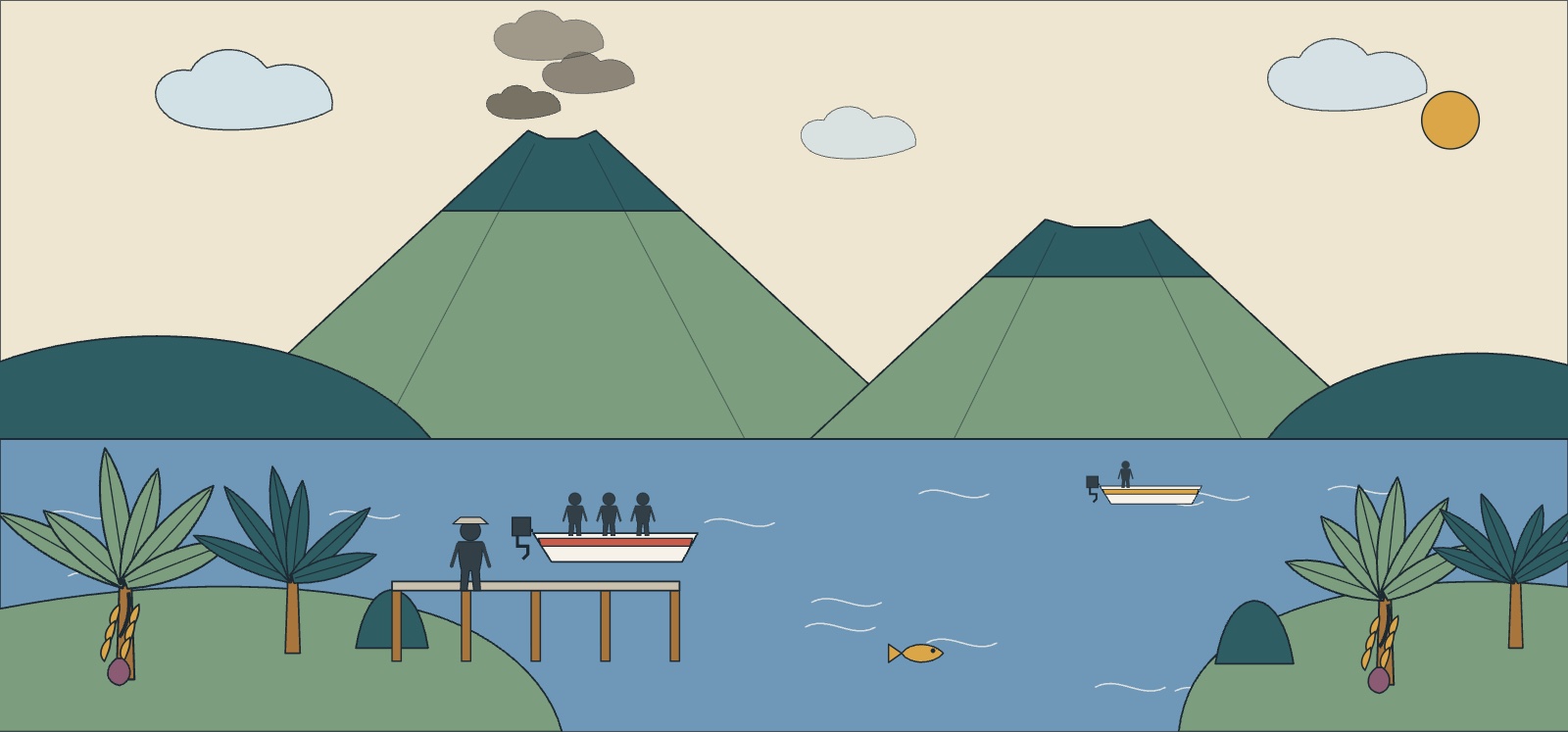
Ometepe and its two volcanoes on Lake Nicaragua. Illustration: MyNicaraguaStay. Illustration : Luxury & Premium Hotel Booking in Nicaragua.
The Papagayo winds are what most visitors do not expect. From December to April, the trade winds funnel through the low pass at Lake Nicaragua and blow hard offshore across the Pacific coast. They groom the surf and they also drive coastal upwelling, which is why NOAA's satellite record puts the sea off the southwest coast at 78 °F (26 °C) in February and 79 °F (26 °C) in March, its coldest of the year, while the air is at its most pleasant.
What to plan for in the dry months:
- Book December well ahead. It is the busiest month of the year by a wide margin, and it combines Christmas with the return of Nicaraguans living abroad.
- Bring a light layer for the boat rides and the wind at San Juan del Sur, Popoyo and Tola.
- Do the volcano hikes and the Mombacho or Telica climbs in the first half of the window, before the March and April heat.
- Expect a short rashguard or shorty wetsuit on the Pacific in February and March if you spend hours in the water.
The green season: May to October
The rains arrive in the second half of May and follow a clear shape: an afternoon storm, then a clear evening. June and July give 8.1 in (206 mm) and 6.3 in (160 mm) at San Juan del Sur, spread over 26 days, but the mornings stay usable. It is the cheapest and quietest half of the year, and the countryside is at its best.
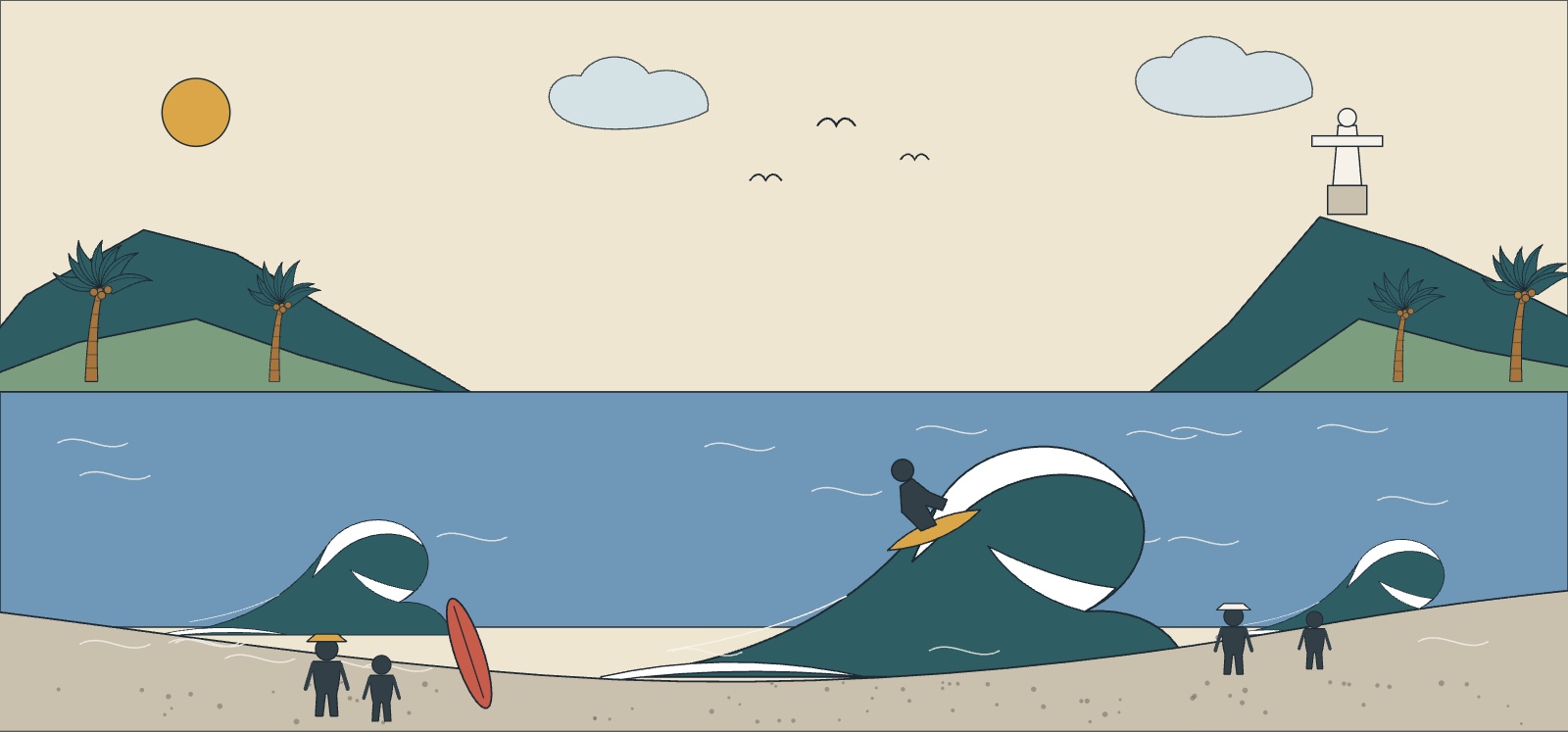
The Pacific swell peaks between April and October. Illustration: MyNicaraguaStay. Illustration : Luxury & Premium Hotel Booking in Nicaragua.
Then September and October break the pattern. San Juan del Sur takes 10.3 in (262 mm) and 12.9 in (328 mm), León 14.1 in (357 mm) and 16.3 in (415 mm), on 27 and 28 rainy days. Roads in the north and on the Caribbean side wash out, and the Corn Islands can lose a flight day. These are the two months to avoid if the trip cannot be moved.
Precautions for a green season trip:
- Plan mornings for the activity and afternoons for the hotel, the lake or the spa.
- Leave a spare day around a Corn Islands or Ometepe connection.
- Take insurance that covers named storms from August onwards.
- Check the road before driving to Matagalpa, Jinotega or the Caribbean coast after several days of rain.
Hurricane season: the Caribbean coast carries the risk
The Atlantic hurricane season runs from 1 June to 30 November, and the NOAA National Hurricane Center puts the statistical peak on 10 September, with most activity between mid-August and mid-October. In Nicaragua the exposure is not shared evenly.
- The North Caribbean Coast region is the landfall zone. Hurricane Eta came ashore about 15 nautical miles south of Puerto Cabezas on 3 November 2020 as a category 4 storm with 120-knot winds, according to the NHC report. Hurricane Iota crossed almost the same stretch of coast two weeks later.
- The Corn Islands sit in that same basin and can lose their air link for a few days when a system tracks through.
- The Pacific coast is largely shielded. Granada, San Juan del Sur and Tola usually feel a tropical system as several days of heavy rain rather than as wind.
- The practical rule: if you want the Caribbean side, go in March or April, outside the season entirely. If you travel between August and October, keep the itinerary on the Pacific and book flexible fares.
Nicaragua month by month
The figures below are for San Juan del Sur, the busiest coastal base. Sea temperatures are for the southwest Pacific coast. Arrivals are international tourists for the whole country, from the last full monthly series published by INTUR.
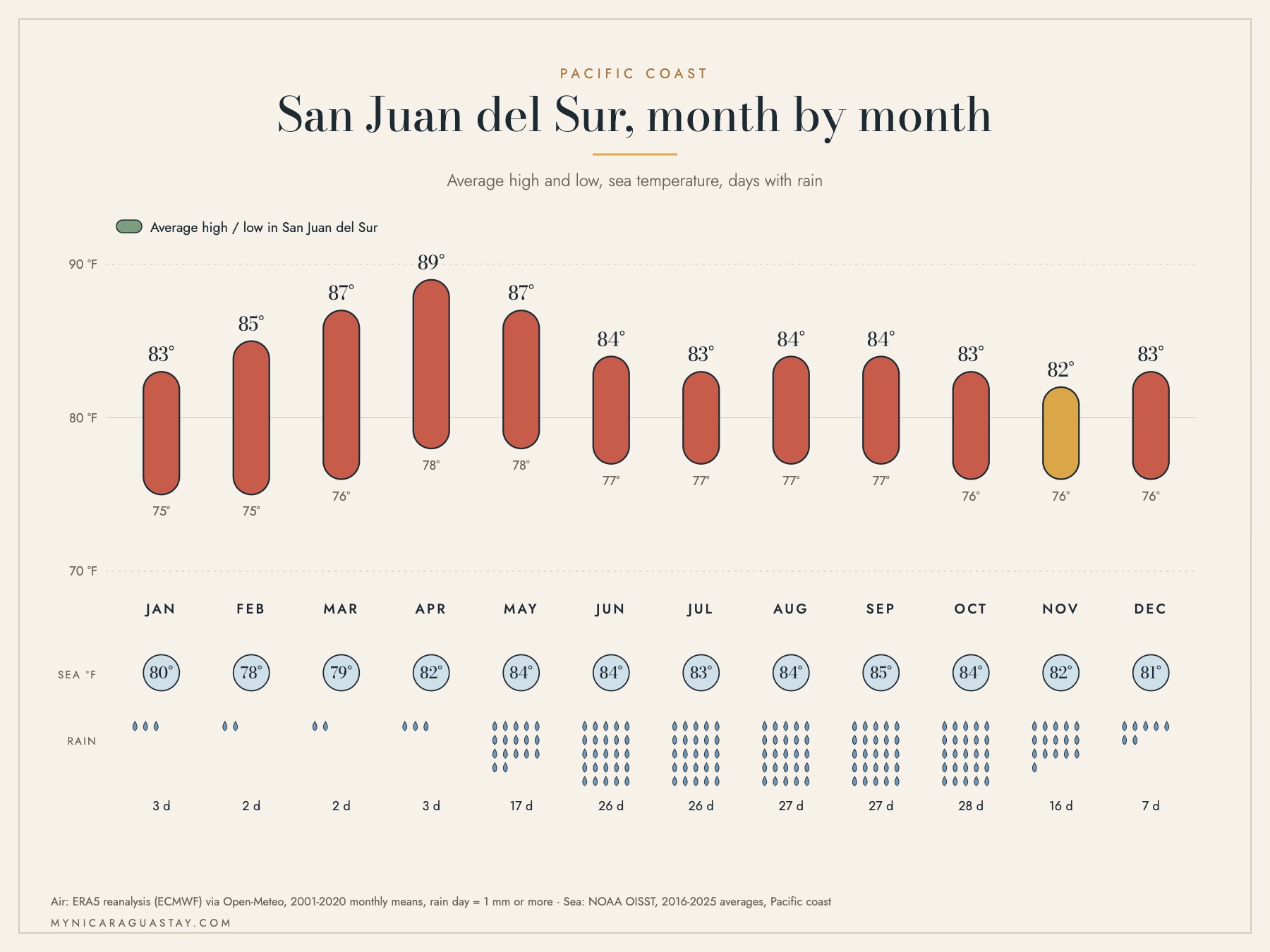
San Juan del Sur month by month. Sources: ERA5 reanalysis (ECMWF) via Open-Meteo 2001-2020, NOAA OISST 2016-2025.
| Month | High / low °F (°C) | Sea °F (°C) | Rain in (mm) | Rainy days | Arrivals 2019 | In three words |
|---|---|---|---|---|---|---|
| January | 83 / 75 (29 / 24) | 80 (27) | 0.4 (9) | 3 | 104,533 | Dry, breezy, green |
| February | 85 / 75 (29 / 24) | 78 (26) | 0.2 (5) | 2 | 88,349 | Driest, windy, quiet |
| March | 87 / 76 (31 / 25) | 79 (26) | 0.2 (5) | 2 | 100,122 | Dry, hot, dusty |
| April | 89 / 78 (32 / 25) | 82 (28) | 0.5 (13) | 3 | 114,912 | Hottest, Semana Santa |
| May | 87 / 78 (30 / 25) | 84 (29) | 8.1 (205) | 17 | 99,938 | Rains return, green |
| June | 84 / 77 (29 / 25) | 84 (29) | 8.1 (206) | 26 | 97,499 | Warm sea, showers |
| July | 83 / 77 (29 / 25) | 83 (29) | 6.3 (160) | 26 | 108,778 | Swell, brief break |
| August | 84 / 77 (29 / 25) | 84 (29) | 7.3 (186) | 27 | 103,188 | Wet, cheap, surf |
| September | 84 / 77 (29 / 25) | 85 (29) | 10.3 (262) | 27 | 92,076 | Wet, empty, cheapest |
| October | 83 / 76 (28 / 25) | 84 (29) | 12.9 (328) | 28 | 97,413 | Wettest, storm watch |
| November | 82 / 76 (28 / 25) | 82 (28) | 3.8 (97) | 16 | 110,392 | Drying, green, good |
| December | 83 / 76 (28 / 24) | 81 (27) | 1.1 (29) | 7 | 178,018 | Dry, festive, busiest |
Air temperature and rainfall: ERA5 reanalysis (ECMWF) via Open-Meteo, monthly means 2001 to 2020, rainy day = 1 mm or more. Sea temperature: NOAA OISST, 2016 to 2025 averages, Pacific coast. Arrivals: INTUR, Boletín de Estadísticas de Turismo 2019, table I.1.
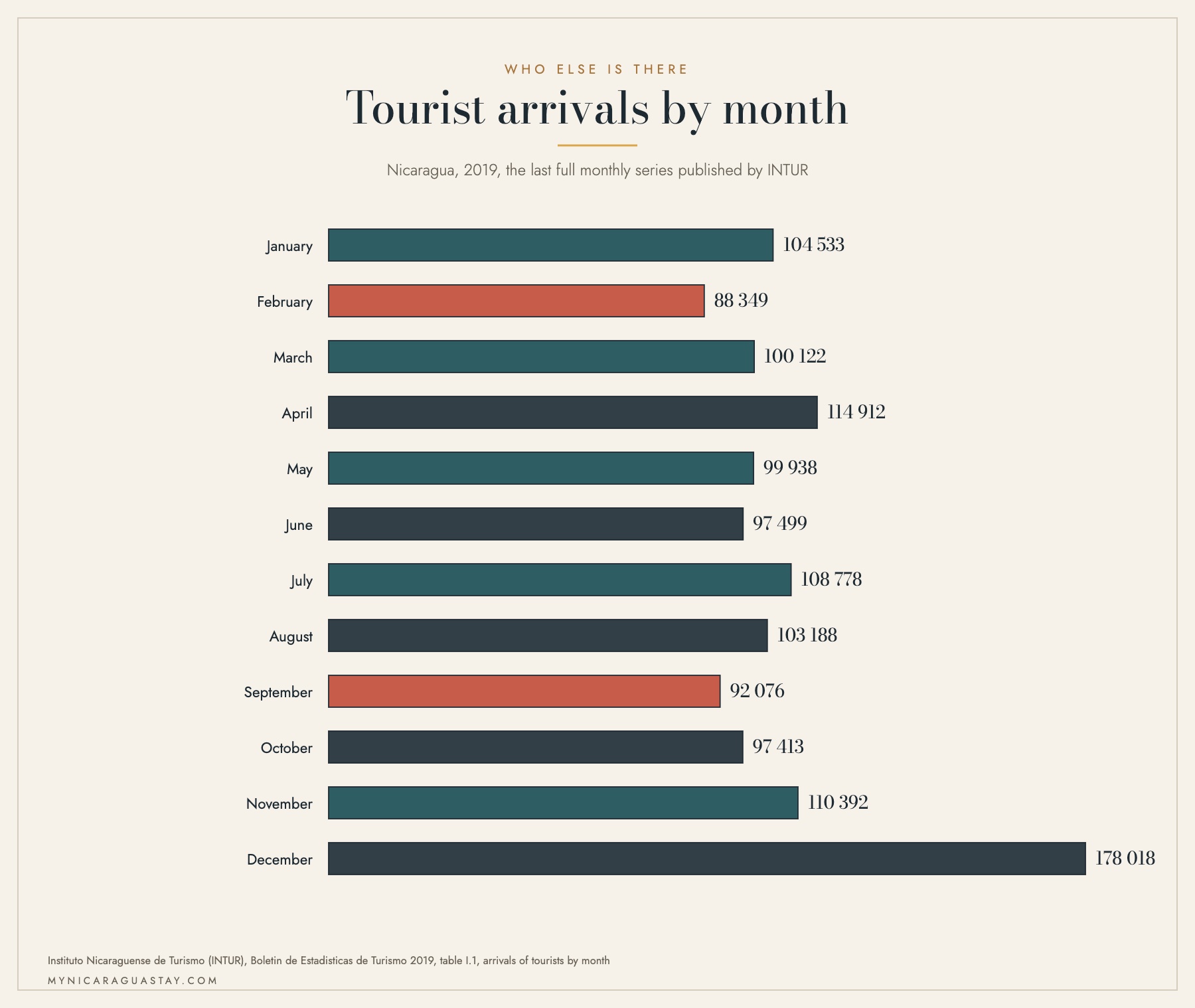
Tourist arrivals by month, 2019. Source: INTUR, Boletin de Estadisticas de Turismo 2019.
The best time for what you want to do
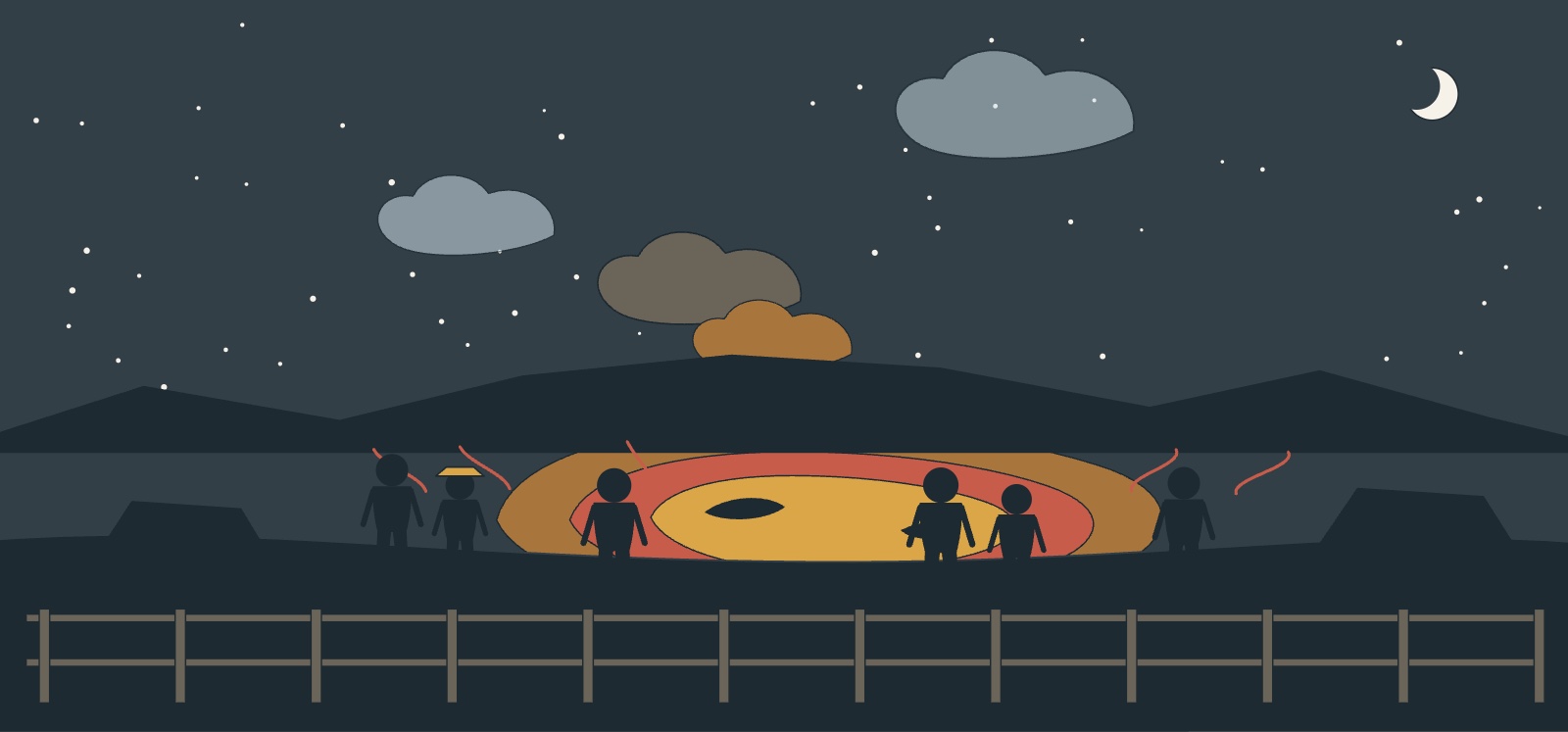
The Santiago crater at Masaya, visited after dark. Illustration: MyNicaraguaStay. Illustration : Luxury & Premium Hotel Booking in Nicaragua.
Surfing
Two different seasons, and they do not overlap. The December to April window gives offshore Papagayo wind almost every morning and smaller, cleaner waves, which suits beginners and longboarders at San Juan del Sur, Playa Maderas and Playa Hermosa. April to October brings the southern hemisphere swell, the biggest surf of the year at Popoyo and Colorado, with warmer water at 84 °F (29 °C) and onshore afternoons. See our guide to surfing Nicaragua.
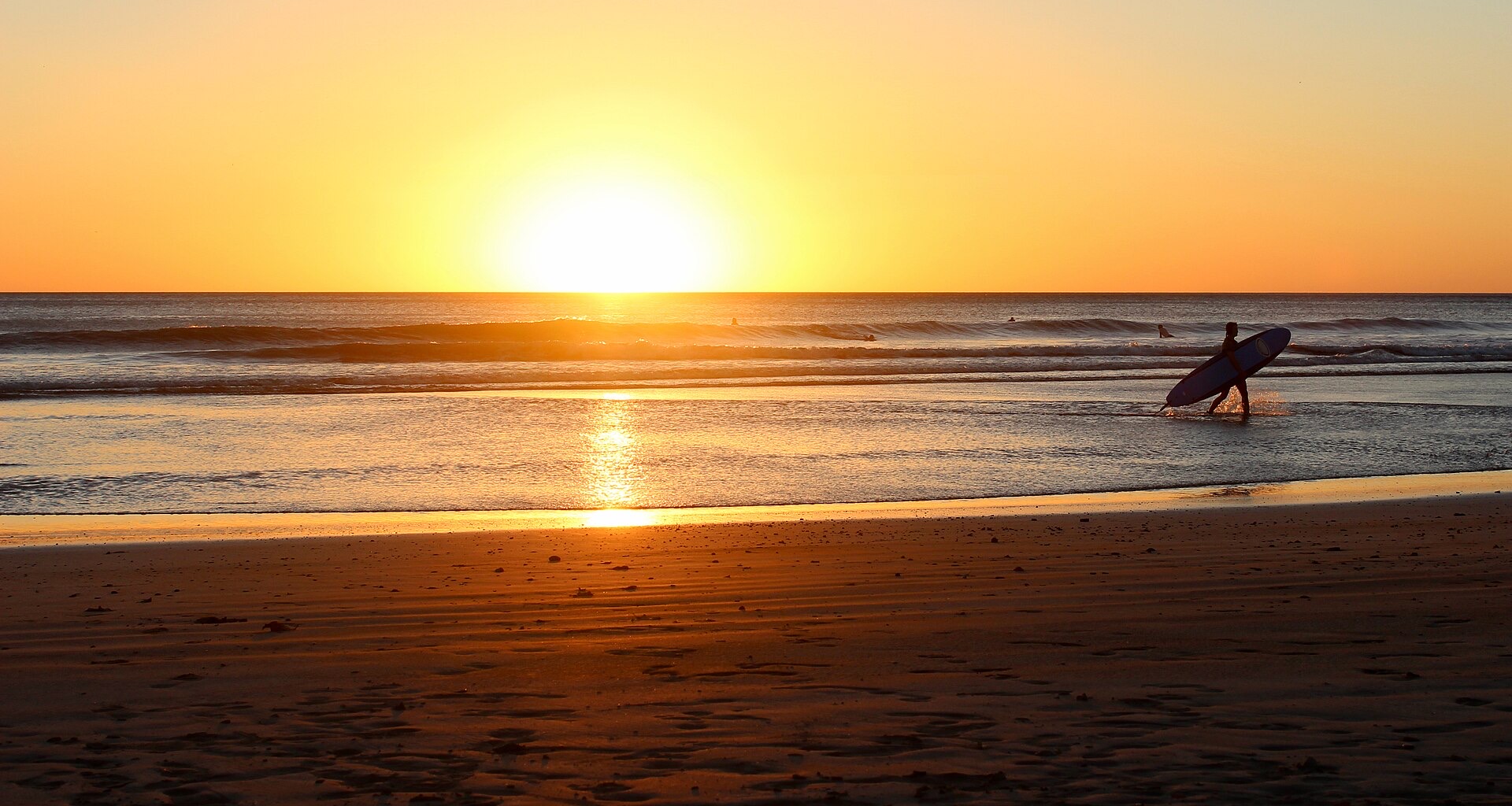
Evening surf at San Juan del Sur. Photo: <a href="https://commons.wikimedia.org/wiki/File:San_Juan_del_Sur,_Nicaragua_(Unsplash).jpg">Paul Biondi</a>, Wikimedia Commons, <a href="https://creativecommons.org/publicdomain/zero/1.0/">CC0</a>. Photo : Paul Biondi, Wikimedia Commons, CC0.
.jpg)
Evening surf at San Juan del Sur. Photo: Paul Biondi, Wikimedia Commons, CC0.
Volcanoes and hiking
December to February, before the heat. Masaya is the one that works in any month because you drive to the rim: MARENA counted 84,556 visits to the national park in the first half of 2026, 44,900 of them foreign. The Santiago crater is visited after dark, when the lava glow in the vent is visible. Longer climbs, Concepción on Ometepe, Telica and Mombacho, are miserable in April heat and slippery in October mud. Read Masaya volcano after dark.
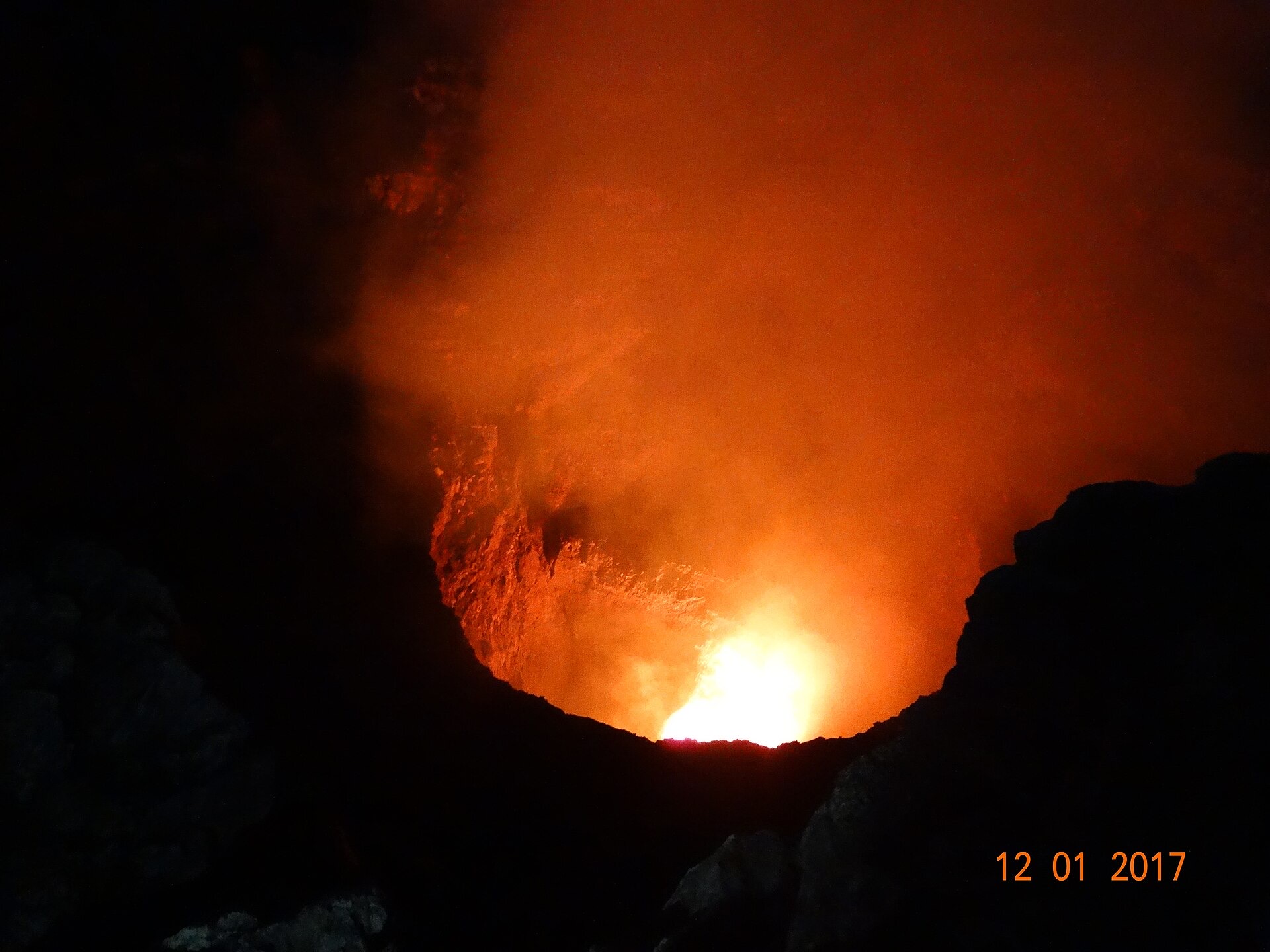
The Santiago crater at Masaya volcano. Photo: <a href="https://commons.wikimedia.org/wiki/File:Masaya_Volcano_-_crater.jpg">Leon Petrosyan</a>, Wikimedia Commons, <a href="https://creativecommons.org/licenses/by-sa/4.0/">CC BY-SA 4.0</a>. Photo : Leon Petrosyan, Wikimedia Commons, CC BY-SA 4.0.

The Santiago crater at Masaya volcano. Photo: Leon Petrosyan, Wikimedia Commons, CC BY-SA 4.0.
The Corn Islands and the Caribbean
March and April, without hesitation. Big Corn Island takes 1.2 in (30 mm) in March against 13.9 in (352 mm) in November, the sea is at 82 °F (28 °C), and the month sits outside the hurricane season. The flight from Managua is short but weather-sensitive, so leave a buffer day. See the Corn Islands guide.
Granada, León and the colonial cities
December and January, when the days are dry and the heat is still reasonable. April is punishing in both cities and Semana Santa fills every hotel. The Granada city guide covers what to do between the hot hours.
Ometepe and Lake Nicaragua
January to March. The lake is choppiest when the Papagayo wind is strongest, so cross early in the day from San Jorge, and expect the ferry to feel it. The island's own trails are firmest in the dry months. See stays on Ometepe.
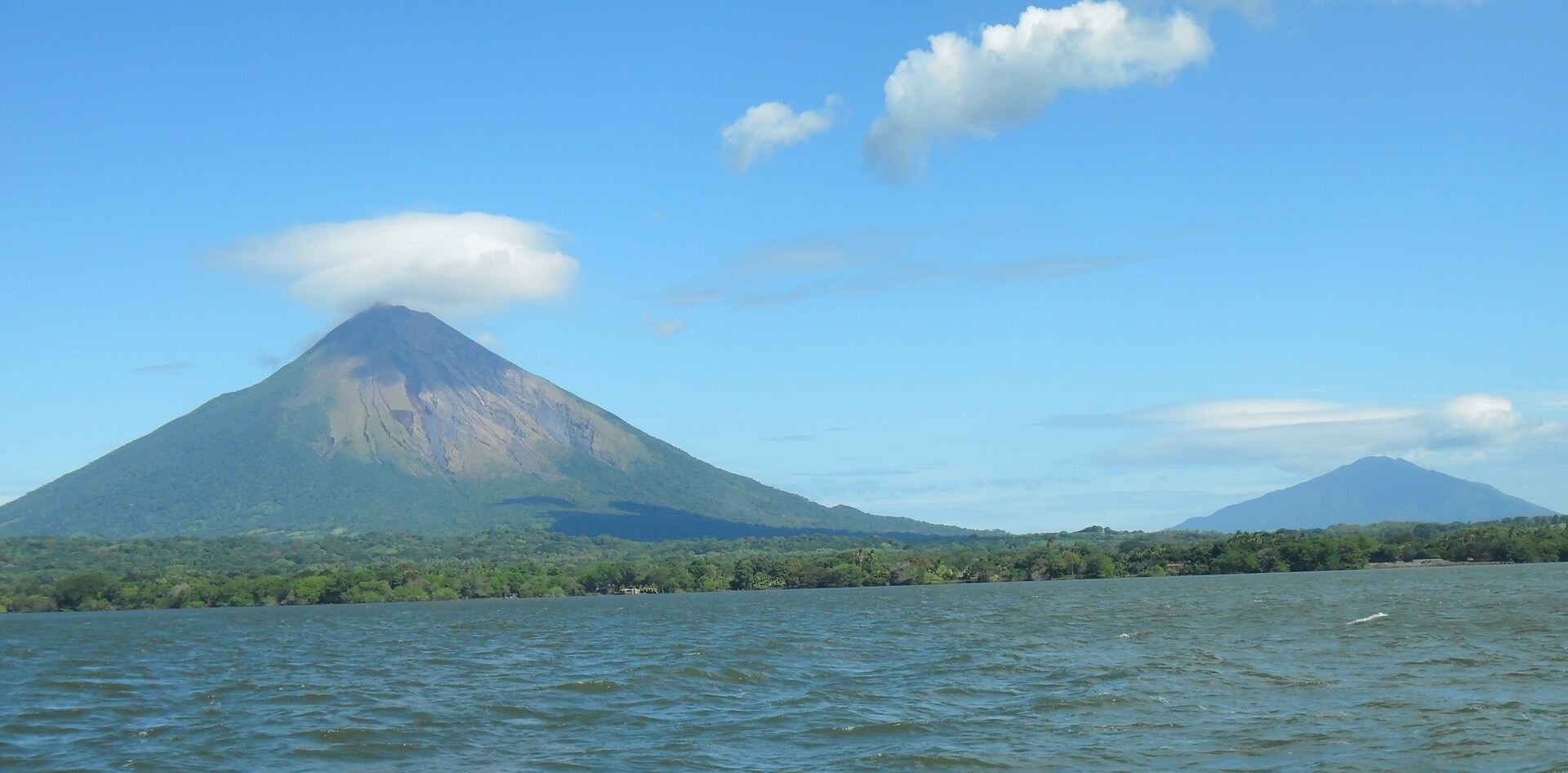
Concepcion and Maderas, the two volcanoes of Ometepe. Photo: <a href="https://commons.wikimedia.org/wiki/File:Ometepe,_Nicaragua.jpg">Milei.vencel</a>, Wikimedia Commons, <a href="https://creativecommons.org/licenses/by-sa/3.0/">CC BY-SA 3.0</a>. Photo : Milei.vencel, Wikimedia Commons, CC BY-SA 3.0.

Concepción and Maderas, the two volcanoes of Ometepe, from Lake Nicaragua. Photo: Milei.vencel, Wikimedia Commons, CC BY-SA 3.0.
Coffee country and the highlands
The harvest runs from November to February in Matagalpa and Jinotega, which is when the estates are working and cool enough to walk. It is also the end of the wet season up there, so the hills are still green. Read the coffee estate stays.
Budget and quiet
September, on the Pacific side. It was the second quietest month in the 2019 series at 92,076 arrivals, and it is the month hotels discount hardest. The trade-off is 27 rainy days. Our September window and August wellness case set out the maths.
Events that shape the year
- Semana Santa, 21 to 28 March 2027: the domestic high point. INTUR counted 5,806,819 people on the move in 2026, of whom 4,123,365 visited 1,570 tourist sites, and the department of Rivas, which contains San Juan del Sur, took 1,251,750 of them. Book the Pacific beaches months ahead or stay away.
- La Purísima and La Gritería, 7 December: the country's own festival, with altars to the Virgin in every doorway and fireworks through the night in León and Granada.
- Christmas and New Year: December brought 178,018 arrivals in 2019, 65 % above the monthly average, partly Nicaraguans returning from abroad.
- Fiestas patronales: each town keeps its own, from Santo Domingo in Managua in early August to San Jerónimo in Masaya in late September, and they close streets for days.
Cruise calls, a dry season affair
Cruise passengers land at San Juan del Sur and Corinto almost only between November and April. In 2019 INTUR recorded 17,141 cruise arrivals in January and 14,349 in April, against zero in June, July and August. If you want the Pacific town without the day-trip crowd, the green season is the answer.
Where to stay, by season
- Hotel Victoriano, San Juan del Sur: on the bay itself, for the December to April window.
- Hotel Plaza Colón, Granada: on the Parque Central, walking distance to everything you can do before the midday heat.
- Little Corn Island Beach and Bungalow: the Caribbean side, best booked for March and April.
- Xalli Beach Hotel, Ometepe: on the lake shore at Santo Domingo, for the dry season crossings.
- Malibu Popoyo: on the swell coast, which peaks between April and October.
- Pacaya Lodge and Spa, Laguna de Apoyo: the crater lake base for a Masaya night visit.
FAQ
What is the best month to visit Nicaragua?
January. The rain has stopped, San Juan del Sur records only 0.4 in (9 mm) over 3 days, the countryside is still green from the wet season, and the Christmas rush is over. February and March are drier still but hotter, dustier, and the Pacific sea drops to 78 °F (26 °C).
What is the rainiest month in Nicaragua?
October on the Pacific side, at 12.9 in (328 mm) over 28 days at San Juan del Sur and 16.3 in (415 mm) at León. On the Caribbean coast the peak comes later: Big Corn Island's wettest month is November at 13.9 in (352 mm), and Bluefields takes at least 11 in (279 mm) in every month from May to November.
Does it rain a lot in Nicaragua?
It depends entirely on the month and the coast. San Juan del Sur goes from 2 rainy days in February to 28 in October, one of the sharpest contrasts in Central America. The Caribbean side never really dries: Bluefields records at least 17 rainy days in every month of the year.
Is September a good time to visit Nicaragua?
Only for a budget trip on the Pacific. September brings 10.3 in (262 mm) of rain over 27 days at San Juan del Sur and sits inside the statistical peak of the hurricane season. In exchange, it was the second quietest month in the 2019 arrivals series and it is when rates fall furthest. Mornings usually stay dry.
Which month is the best to surf in Nicaragua?
It depends on your level. For clean, manageable waves and offshore wind almost every morning, go December to April. For the biggest swell of the year, go June to September, when southern hemisphere groundswell reaches Popoyo and the water is at 84 °F (29 °C). April and May sit between the two.
What is the worst time to visit Nicaragua?
October. It is the wettest month almost everywhere, with 28 rainy days at San Juan del Sur and 12.9 in (328 mm) of rain, it falls inside the Atlantic hurricane season, and the Caribbean coast is at its most exposed. Late September is a close second.
Is November a good time to visit Nicaragua?
Yes, and it is underrated. The rain drops to 3.8 in (97 mm) over 16 days at San Juan del Sur, the country is still green, the sea is at 82 °F (28 °C) and prices have not yet reached the December level. The caveat is the Caribbean coast, where November is the wettest month of the year.
How long do you need in Nicaragua?
Ten days covers the classic loop: Granada and the isletas, Masaya at night, two nights on Ometepe, then the Pacific coast around San Juan del Sur or Tola. Add three days for the Corn Islands, which need their own flight, and three more for the coffee highlands of Matagalpa and Jinotega.